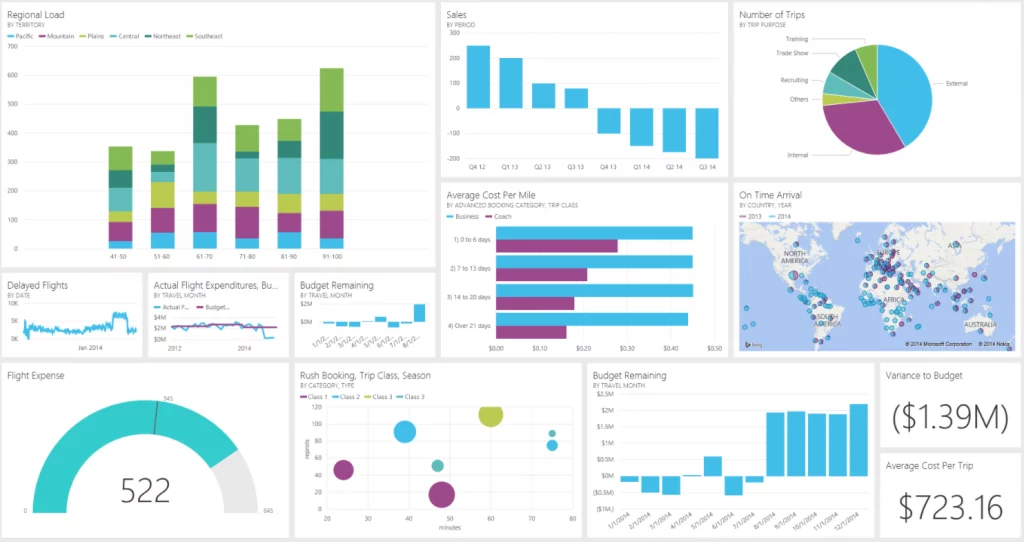
When evaluating corporate performance management (CPM) software, people are often confused between Business Intelligence (BI) and Corporate Performance Management (CPM) solutions. The fact that both sets of software solutions frequently include graphical dashboards and interactive analytical capabilities may have caused this question. While they may appear to be comparable on the surface, CPM and BI are actually quite distinct.
Here’s a short overview of these concepts and technologies, what differentiates them, and how they work together to clear things up.
What is BI?
One of the most in-demand software solutions nowadays is business intelligence software. BI tools examine the data you’ve gathered and then utilize it to uncover patterns and trends that might help you make better business decisions.
These systems also include reporting tools that provide data visualizations. Data visualizations are visual displays, such as charts and graphs, which help people comprehend the outcomes of data analysis. Many BI systems include a data warehouse, which stores your data and allows you to access it while conducting analysis. Others include a more condensed version for business reporting, a more analytics-focused version, large data processing modules, and some can even be integrated into other applications!
BI features include: Data Collection, Data Visualization, Data Lineage Tracking, Interactive Visualizations, Reporting, Analytics, Dashboards, Predictive Modeling, Workflow Collaboration, OLAP, Document Management, Decision Services, Big Data Integration.
What is CPM?
Corporate Performance Management (CPM), also known as Business Performance Management (BPM) or Enterprise Performance Management (EPM), is an instrument for evaluating how well a company operates. “An umbrella term that describes the methodologies, metrics, processes, and systems used to monitor and manage the business performance of an enterprise” according to Gartner.
To put it another way, CPM aids in the tracking of your success by monitoring the key performance indicators (KPIs) and performance metrics you’re aiming for. Most of the CPM software does this through planning, forecasting, and budgeting.
CPM features include Goal Management, Performance Evaluation, Employee Lifecycle Management, Succession Management, Compensation Management, Reporting/Analytics.
Similarities
As you can see from the above feature lists, BI and CPM serve very distinct purposes. Both are utilized as a part of a company plan to streamline everything from day-to-day operations to annual events, and both focus on enhancing your business processes.
Both systems are capable of handling data management. They enable users to combine various forms of data to create a picture and obtain a better understanding of a business topic. In a few areas, such as reporting and analytics, their capabilities overlap as well. Both systems have the ability to generate reports based on predefined metrics.
Differences
Visualizing your data
The first main difference between CPM and BI is in their output. BI is mainly used to create visualizations, from simple graphs and charts to interactive graphics. Businesses who require a quick way to visualize their data, putting it into a format where it is easier to spot trends, can use BI tools.