- Services
- Partners
- Solutions
- Resources
The CFO's guide to AI-powered FP&A
Watch this on-demand webinar to learn how AI is reshaping FP&A for modern finance teams.
- Company
Upcoming Webinar
Vena isn’t just for financial planning. Beyond budgeting and forecasting, it can also power your incentive compensation programs.
- Contact Us
Why 95% of AI Initiatives Stall… and Ultimately Fail
Here is a 5 step process that shows you exactly how to overcome that statistic.
Why Enterprise AI Projects Stall
AI is not failing because the models are weak. Most initiatives stall because enterprises have not yet
aligned the use case, the data, the integration layer, the governance model, and the path to scale.
For executive teams, the implication is straightforward: stop treating AI as a science experiment and start
treating it as an operating-model transformation. The organizations seeing real returns are not chasing
generic AI hype. They are solving one measurable business problem at a time, grounding AI in enterprise
data, and integrating the result back into real workflows.
Imagine you are at the airport, about to get on the plane
The gate agent keys the mic on the intercom, “Flight 737 to Lincoln International Airport now boarding first class passengers…We would like to inform all passengers that due to technical difficulties, there is a 95% chance we will not make it to our destination. Please have your tickets ready! And make sure you only have one carry-on item”

What do you do?
- Just get on and hope for the best?
- Run for the door and never fly again?
- or.. Figure out how to fix the problem so you can get to where you are going!
95%
of enterprise GenAI pilots studied had no measurable P&L impact.
5%
crossed the divide by integrating AI into real workflows.
Enterprise Integration
The problem is not the model. The problem is enterprise integration.
Request the Full Whitepaper
Most enterprise AI programs do not fail because the model is weak. They fail because the organization has not yet built the data, workflow, governance, and scalability foundations required for production value.
That 90-point gap between pilots and production isn’t a failure of the underlying models. It’s a failure of enterprise integration: pilots get built in isolation, disconnected from governed data, real workflows, and the operational systems that actually run the business. A demo can succeed in a sandbox and still never touch a P&L, because nothing was built to connect it to one.
This is where Delbridge and MongoDB come in. MongoDB’s document model and native vector search give enterprises a single, flexible data layer that AI applications can actually be grounded in, no brittle pipelines, no bolted-on search index, no separate system to keep in sync. Delbridge builds on top of that foundation, bringing the governance, integration, and delivery discipline that turns a working prototype into a system the business can trust and scale. Together, that combination is what closes the divide, and it comes down to five concrete moves.

What Leadership Should Remember
According to MIT/NANDA’s State of AI in Business 2025, the majority of enterprise GenAI pilots still show no measurable P&L impact.
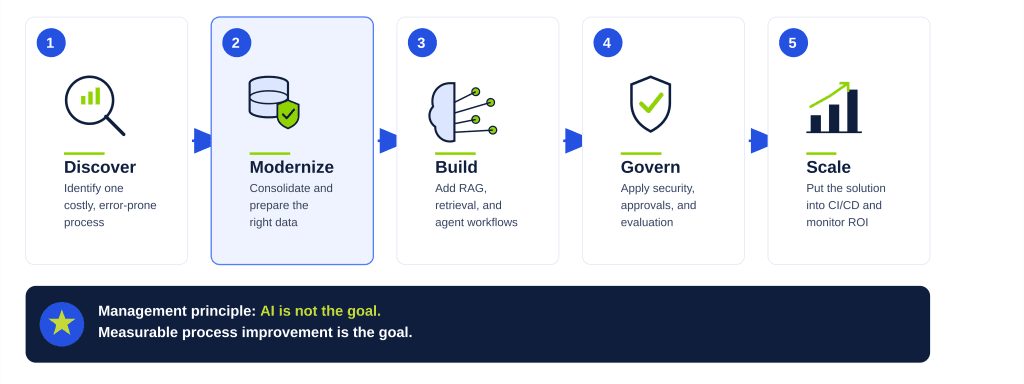
AI is not the goal! Measurable process improvement resulting in positive ROI is the goal.
Five Ways Good Pilots Die Quietly
The failure pattern is consistent across industries. Executive teams often approve a promising proof of concept, but the initiative loses momentum before it becomes part of daily operations.
- The business problem is vague. "Do something with AI" is not a strategy. The best programs target a specific, measurable process such as customer service resolution, claims triage, logistics decisions, or employee support.
- The right data is trapped in legacy systems. Valuable context is usually scattered across ERP, CRM, documents, emails, logs, and operational systems. If the data is not accessible in an AI-friendly format, the model cannot deliver reliable results.
- The integration layer is missing. Even when AI can generate a good answer, it creates little value unless it can trigger the next step through APIs, workflows, approvals, and system actions.
- Security and governance are treated as afterthoughts. Hallucinations, prompt injection, sensitive data leakage, and uncontrolled actions can undermine trust and create compliance risk.
- The solution never leaves the laptop. Many pilots prove a concept in isolation but fail when they must run with enterprise-grade CI/CD, observability, performance controls, and cost discipline.
- No one owns the ROI. If leadership does not define success metrics in advance, there is no objective way to separate a novelty from a production asset.
What an AI-Ready Enterprise Should Look Like
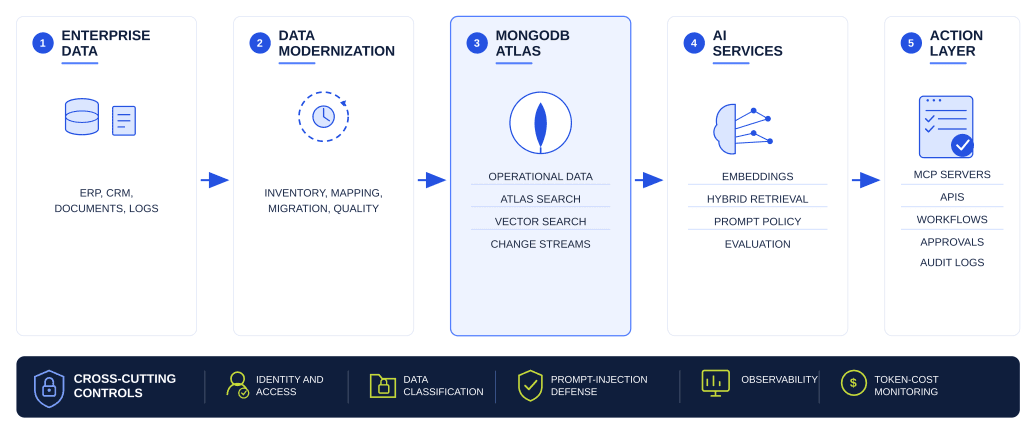
The Five Moves From Pilot to Production
These aren't abstract best practices. Each move closes one of the specific gaps that keep pilots stuck in the sandbox, from a vague business case to a missing integration layer, so the work can graduate into something the business actually runs on.
- Define one measurable use case. Pick a process with clear pain, repeatable work, and a visible KPI. Good examples include document-heavy service processes, operational triage, employee support, and repetitive cross-system tasks.
- Modernize AI-ready data. Inventory the data required for that use case, fix quality issues, and move the relevant context into a platform that supports both operational workloads and AI retrieval.
- Ground the solution with RAG and vector search. Retrieval-Augmented Generation reduces hallucinations by giving the model access to current enterprise context at query time. MongoDB Atlas Vector Search is designed for this kind of semantic retrieval.
- Integrate through governed MCP. MCP provides a standardized way for AI applications to connect to external systems and tools. In practice, this means AI can retrieve context, call APIs, and participate in workflows while remaining inside policy guardrails.
- Scale with CI/CD and cost control. Treat AI delivery like software delivery. Build testing, prompt evaluation, security controls, telemetry, and token-cost monitoring in from the start.
The 5-Step Executive Playbook
Core Design Principles
- Unify operational and AI data. MongoDB Atlas combines a flexible document model with native search and vector-search capabilities, reducing architectural sprawl.
- Keep context close to the workflow. Store structured data, unstructured content, and AI-generated metadata in a model that supports retrieval and action in one flow.
- Separate retrieval from action. First retrieve the best context; then let governed agent services decide whether to draft, recommend, or execute.
Mandatory Controls
- Identity and access management across users, agents, and services.
- Data classification and policy enforcement so the model sees only what it should.
- Prompt-injection defenses and approval gates before any external action.
- Observability and token-cost monitoring to manage reliability and economics.
- Audit logs and evaluation harnesses to support trust, compliance, and continuous improvement.
Fastest Path to Value
The fastest path to value is not a broad AI mandate. It is a focused 90-day program with named owners, defined metrics, and enterprise-grade design choices.